

Check Book: Weepy Sheep
Life, death, and The Sheep Detectives


IN THIS WEEK’S EDITION:

THE BARDI PARTY REPORT
Wake up, sheeple. There’s a new five-star masterpiece in theaters, and I’m not being glib in the manner of Griffin Newman calling Small Soldiers a five-star masterpiece. The Sheep Detectives is a legitimate triumph.
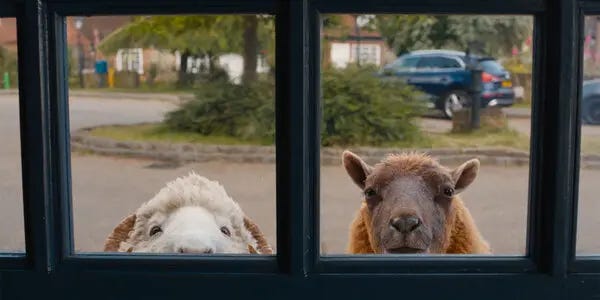
If you’ve been living under a rock, or had the wool pulled over your eyes (sheep pun), The Sheep Detectives is directed by Kyle Balda (of my beloved Minions) and written by Craig Mazin (Chernobyl!?! The Last of Us?!?!) and follows a group of sheep who, after the murder of their kindly shepherd (Hugh Jackman) attempt to solve his homicide. The supporting cast of townspeople includes Emma Thompson as Jackman’s lawyer, Molly Gordon as his estranged daughter, Hong Chau as a quirky local innkeeper, Nicholas Braun as a bumbling policeman, and Nicholas Galitzine as an ambitious local reporter. The sheep themselves are voiced by a murderers row of Julia Louis-Dreyfus, Bryan Cranston, Regina Hall, Patrick Stewart, Chris O’Dowd, Bella Ramsay, and two Brett Goldsteins.
When I first saw the trailer for this, I laughed at the implausibility. What if Babe was Benoit Blanc, and Cousin Greg from Succession had a British accent, and Hugh Jackman was DEAD? One ticket please! What I wasn’t expecting was a moving exploration of loss and grief, and a wonderful new entry in the “children’s films about death” canon. Animals coming to terms with their own death for human consumption is a fairly well-worn trope. While The Sheep Detectives touches upon that, it’s more interested in death as a natural part of life (Hugh Jackman’s murder notwithstanding!) and how those who go on living memorialize those they’ve lost. I sobbed through the last third of the film.
I know Griffin speaks often of his childhood obsession with death - I had one, too. My favorite film as a child was Agnieszka Holland’s The Secret Garden, which is also an exploration of grief and spiritual rebirth. I didn’t endure anything particularly traumatic as a child, so this whole death thing wasn’t coming from a place of lived experience. I am, however, naturally very curious, and curious people tend to ask lots of questions and ruminate through rabbit holes. What happens when you die? Will I die? Is there a God? What’s the whole deal with God? Lily - our sheep detective protagonist - is also a curious type. I think one of the main reasons I loved The Sheep Detectives is that it reminds me of the best family-oriented films from my childhood, films that encouraged children to think and feel, as opposed to slop that is meant to distract and promote merchandise. Although, to be fair, if they released a Winter Lamb stuffed animal, I’d buy that shit in a heartbeat.
Anyway - go see The Sheep Detectives whether you have children or not. Hug your loved ones. And appreciate the in-film joke about Return to Oz, another children’s movie about death, that felt especially targeted to freaks like us.


LET’S CRACK OPEN THE AUSSIER
Spiritual Cinematography
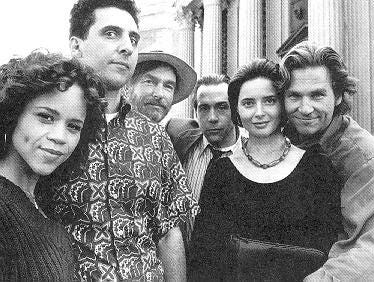
When Australian New Wave icon Peter Weir shifted his career over to Hollywood, he spent the majority of his first half-decade in the States working on studio projects with clear commercial ambitions. Though there were outliers—like 1986’s The Mosquito Coast, which deliberately sought to break from the American narrative tradition, resulting in tepid box office returns—films like 1985’s Witness, 1989’s Dead Poets Society, and 1990’s Green Card were conscious crowdpleasers, despite their (oft-abundant) idiosyncrasies. In the early 1990s, though, Weir was ready to return to the heftiness of his earlier work: “Strangely, I felt uneasy about [Green Card’]s success. I’d enjoyed doing it very much, but it was too comfortable. I wanted to deal with more difficult subject matter.”1 So Weir put out a call—or maybe a challenge—to producers: “[S]end me things that you consider in raw shape, give me the broken ones, the sad cases, the ones in the too-hard file.”2 It was soon answered by producer Mark Rosenberg, who provided Weir with a draft of Rafael Yglesias’s ambitious (if disjointed) screenplay for the film that would become 1993’s Fearless.
In this week’s episode of Blank Check, much attention was paid to how Weir’s renewed desire for the unconventional and weighty manifested in the film’s story. But undiscussed was how these aspirations extended to the film’s style and Weir’s approach on set, too. Speaking with Movieline in September 1993, Weir laid out his loftiest goal: “When I started this film, it occurred to me how interesting it would be to attempt to ‘photograph souls’.” By photographing souls, Weir clarified, he meant images in which “you can see faces where there is no projection of what they would like you to see.” On set, Weir said, “I tried to create an atmosphere with my cast where they, without knowing it, would allow me to photograph them without any barrier.” This wasn’t for every set-up—“after all,” Weir noted, “these are professional craftspeople”—but “each cast member, in one or two or three moments, allowed me to photograph them that way,” typically in a close-up. Weir knew how this might read: “It sounds so pretentious saying you’re ‘photographing souls’.” However, he admitted, “I don’t know how else to put into words what was really mostly an intuition.”3
Weir shared an example of what he meant by all of this in a 2018 interview with the author John C. Tibbetts. Late in Fearless, Jeff Bridges’ character, Max Klein, eats a strawberry and suffers a catastrophic allergic reaction. When Bridges arrived early in the morning to shoot that sequence, Weir said, “he had this quality about him… something different about him.” He was ready, you could say, for his soul to be photographed: “I mean, there was nothing between him and the lens. There was no artifice. Think of early photographs, before people knew what cameras were, or children, when they didn’t know they were looking into a camera.” It wasn’t an “angelic look or anything,” Weir said, just “a look of some utter purity.” So Weir found, “[w]hat I was photographing was a soul.” And when Weir “went home that night,” he left the set “thinking that was one of the greatest experiences of my life as a filmmaker, to have watched, to take that close-up.”4
The next morning, Weir received news that seemed to confirm that he had captured something special: Bridges was unable to report to the shoot that day, as he had developed an illness. He would, in fact, ultimately miss somewhere between a week to ten days of the production, forcing Weir to shoot around his film’s protagonist as much as reasonably possible. When Bridges returned to the set, Weir remembered, “He … said, ‘I’ve never had that in my life; I’m a very healthy person.’ He said it was like getting shot with a bullet. My own theory was that he’d lowered his immune system during those scenes. He went to death’s door, in my opinion.” In his work, Weir said, “I’m trying to get as close to what Jeff got close to that day.”5 It was a profound experience for Bridges, too: “Usually I come away from a film feeling disoriented or like I’m watching a home movie. But this still makes me feel how frightening and exciting it is to be alive and how fear and love are both involved in that--the two partners of life, dancing together.”6

WHAT IS THE TEAM INTO THIS WEEK?
AJ McKeon, Editor: “Sugar Mama’s Bake Shop in Austin. If you’re in town, check it out. They have a great cupcake called the Sweet Jane, and it is vegan, gluten-free, and dairy-free. I know that probably sounds like it would be gross for a cupcake, but I can attest that it is not gross and it is in fact delicious.”
JJ Bersch, Researcher: ““I am playing the video game Mixtape, which is not my recommendation, as I don’t think it’s very good. BUT the game does have a prominent needledrop of “Monochrome” by Lush, the band that is secretly both the best Britpop and the best shoegaze band of all time. So, play the game if you want to keep up with the discourse or whatever—or if you have a higher tolerance for the works of John Hughes—but also, you could just go listen to Lush, you know? (And then watch Lush: A Far from Home Movie, a 36-minute compilation of tour footage shot by bassist Phil King, previously exclusive to the Criterion Channel but now streaming on 4AD’s YouTube page.)”
Alan Smithee, Pseudonymous Editor: “I have not finished with it yet, so maybe it will take a turn, but I’m sort of blown away by this game I’m playing, Indika. You play as a nun in 19th century Russia who is sort of an outcast in her convent because, well, she’s pretty tight with the devil (who narrates the game, Stanley Parable style). She ends up traversing the Russian countryside with an escaped convict. It’s pretty light on gameplay mechanics, but it looks incredible (great… cinematography?). Score is awesome. It’s got a lot of fun, meta elements. Great voice acting. It’s sometimes funny, sometimes sad, sometimes very spooky! Play it!”

THIS WEEK ON THE PODCAST
“Hitmaker” Timothy Simons joins us to chat about Jeff Bridges, Rosie Perez, “pink cloud syndrome,” and aerophobia in this episode on Fearless, so fasten your seatbelts and brace for impact!.
CRITICAL DARLINGS
“…You think that you've made a choice that exempts you from the podcast industry when, in fact, you're listening to a podcast that was selected for you by the people in the room…and Who? Weekly!” This week on the show, we’re joined by the hosts of , Lindsey Webber and Bobby Finger, to discuss The Devil Wears Prada 2, starring a list of all-star Thems: Meryl Streep, Anne Hathaway, Emily Blunt, and Stanley Tucci.
MEANWHILE ON PATREON…..
A sibling’s choice for a bonus ep… groundbreaking. We’re returning to Runway for an episode a million girls would kill for with The Devil Wears Prada 2. Joined by sibling of the show Romilly Newman, we discuss key jangling, ungirded loins, nostalgia only in the hype cycle, and more.


COMING SOON:

DGA Quarterly, Summer 2010.
New York Times, October 13, 1993.
Movieline, September 1993.
John C. Tibbetts interview, July 9-20, 2012, in Peter Weir: Interviews, ed. John C. Tibbetts.
Ibid.
Los Angeles Times, October 10, 1993.
🙌🙌🙌🙌
I've been so mixed on Mixtape, I like the concept and the way it blends story with gameplay, but I think the story itself is so poor, clumsy, and boring. Good idea, poor execution.