

Check Book: Mad Scientists
The Bride, Hoppers, and the beginning of our Peter Weir series


IN THIS WEEK’S EDITION:
THE BARDI PARTY REPORT
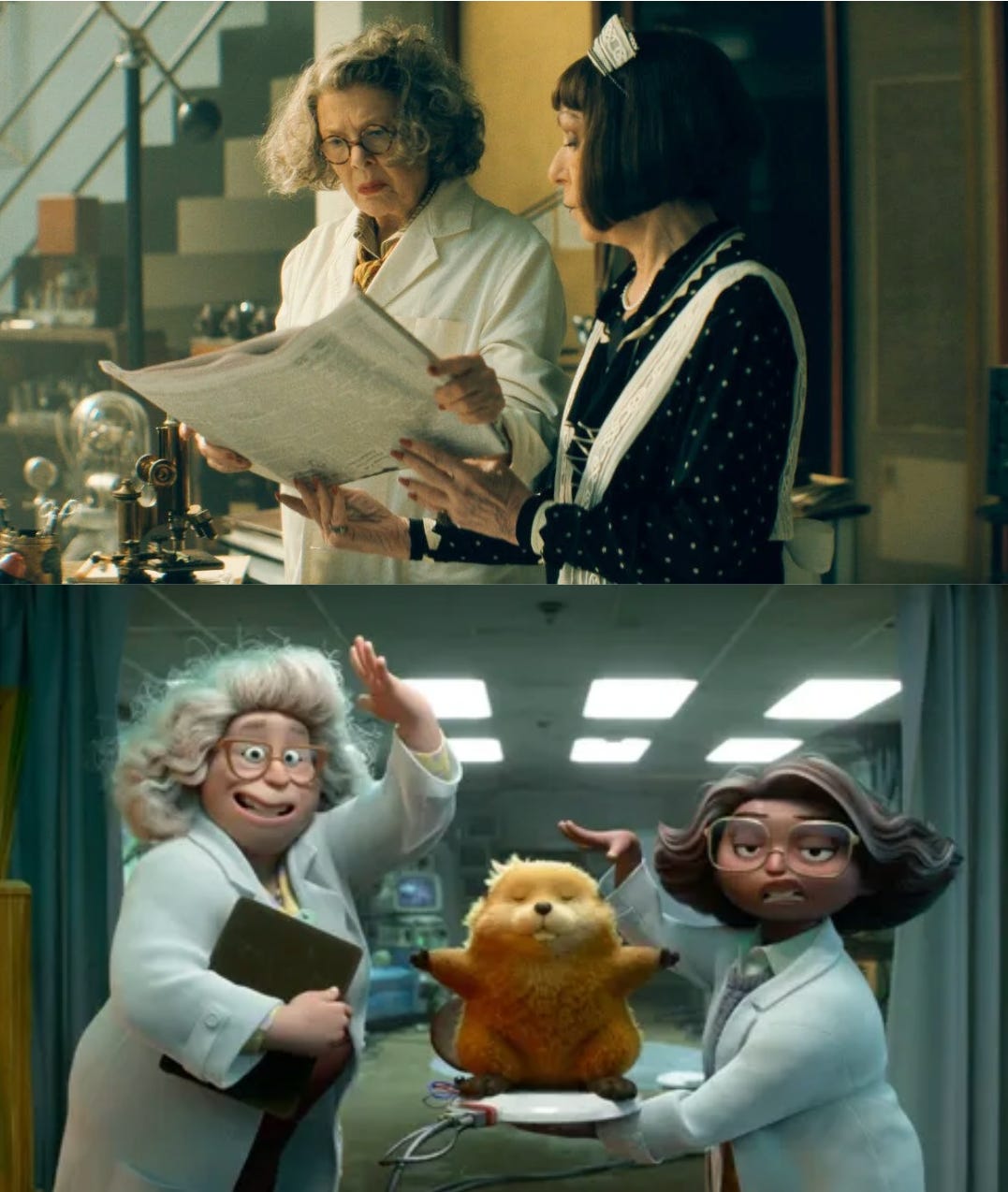
For the first time in a long time, it felt like I spent my weekend at the movies. I bravely left my apartment twice to see two new releases - The Bride and Hoppers. I saw both with Griffin Newman. Both films featured female mad scientists with shoulder length gray hair and glasses. That’s where the similarities end. My assorted thoughts - some spoilers ahead:
THE BRIDE
Oh Maggie. We’re neighbors(ish) and I don’t think you’re probably that busy right now, so let me take you out for a drink. I’d love to pick your brain. I looooved The Lost Daughter. I neeeeed to know what happened here. The Bride is a mess. It’s a real frankenmovie, including references not only to the James Whale movies, but to Rocky Horror (never thought I’d see Jeannie Berlin looking like Magenta) and to Young Frankenstein. Jessie Buckley gives a frankenperformance, oscillating between generic gangster’s moll and a truly insufferable version of Mary Shelley that feels more like Johnny Depp doing Captain Jack Sparrow than anything else. There’s far too much going on at all times - too many genres, too many Academy Award-nominated actors in thankless roles, too many gestures at already dated contemporary gender politics - but instead of feeling like a fascinating mess, it’s just muddy. It made me sad.
Some things I did like:
I thought Christian Bale was actually pretty great as Frankenstein. I’d watch a whole movie of him moping around Chicago going to movie theaters and longing for Jake Gyllenhaal in a queer-coded way. It’s a shame that in a movie that’s supposed to foreground “The Bride,” the groom is the most interesting thing.
I generally liked all of the allusions to classical Hollywood stuff. Jake G has a pretty perfect talking-pictures tenor. Who knew?
The character design is pretty striking. I liked the black stuff (bile?) on Jessie Buckley’s face, and her orange dress and wild peroxide hair.
Because I saw this movie at Nitehawk, I ordered off their special menu - an insane Chicago dog that looked like this:

It was messy, but otherwise pretty good.
HOPPERS
Now this one, I did like. In the past ten years of Pixar releases, I’ve only really LOVED two films (Coco and Turning Red), so my expectations were fairly low. Hoppers proved a delightful surprise! First and foremost, I must proclaim that I would lay down my life for George the Beaver King. THAT is what positive leadership looks like. As for the plot, I genuinely had no idea where things were going, in spite of the fact that the movie itself acknowledges its similarities to Avatar. Also, there’s a Bikini Kill needledrop and the main character is a teenage girl who spends most of her time yelling at politicians. It’s COOL and FRESH! I think Ben Hosley would like this movie!
I also must take this moment to admit that I saw this movie in 4DX, a format that I’ve never really been interested in despite Griffin’s evangelism. I don’t know if I will be returning to the 4DX experience. It doesn’t really seem conducive to eating popcorn or drinking soda. I think if I tried to eat anything, I’d throw up.

LET’S CRACK OPEN THE DOSSIER
Some context for the context: this is now the second straight miniseries in which I have finished all of my research before any of the episodes have been released. (This will also, barring any absolute disasters, be the case for our next miniseries, too.) For the most part, this is a good place to be: I will have the full context of Peter Weir’s career in mind each time I sit down to write these newsletters. However, this also means that I have one big regret: it wasn’t until sitting down to write this issue that I realized I should have been calling them Aussiers this whole miniseries. In the future, I promise I will think more seriously about any potential dossier puns before I submit any research documents to my podcast overlords. And yes, whatever, I’m probably fired. C’est la vie (and carpe diem, for the matter).
Telling Lies, Playing Games
Even early in his childhood, Peter Weir craved the attention of an audience. In particular, one audience member: his mother Peggy. When Weir would come home from his day adventuring around Vaucluse, he’d head straight to his mom, who was waiting with a cup of tea in anticipation of another one of his tall tales. Each would typically start from something innocuous: “[T]here’d be an incident on the tram, on the trolley or on the bus, some minor incident, you know; maybe a lady’s shopping bag burst and fruit and vegetables were rolling around the bottom of the bus,” Weir told the writer John C. Tibbetts. But when Peggy would ask what happened next, Weir would leap at the chance to improvise something more elaborate, more riveting: “I would put a kind of twist on things, maybe about a boy who trod on a tomato and how angry the lady was, because she was very poor.” Peggy found the stories so engrossing that she would ask Peter to recount them days later to other family members in what sounds like an absolutely embarrassing—and stressful—display: “The problem was, that a day or two later if my aunt dropped in, my mother would say, ‘Peter, Pete, come and tell Aunty about the bus and the bag of vegetables!’ And I’d think, Oh my, god, I’d forgotten what I’d said. She’d tell everybody to sit down; and then I’d have to crank it out, get myself back into the spirit of the thing.”1 Lying: it’s a good storytelling exercise for a burgeoning filmmaker.
Weir’s other early efforts at creativity received less approval from his parents. As Weir told the author Sue Matthews, from a young age, he “played very elaborate games,” many of which were his own primary inventions. Though they “took various forms,” they “were generally war games, beginning with lead soldiers.” Befitting a director who would later wrangle massive sets, Weir was not a lax gamemaster: “There were very strict rules: if you got shot you really had to lie down, and you couldn’t go ‘pow,’ you had to make it sound like a gun.” But no matter how serious his play was, his parents did not want him to continue wasting his time on something so frivolous: “When I was twelve or thirteen, my parents became very concerned about these games, and had a talk with me, more or less saying that these sorts of games have gone on too long. I remember that conversation at the breakfast table really having some impact on me, and I moved onto other things after that.”2 Sometimes you play war games until you hit your teenage years, other times you don’t stop drinking milk out of a bottle until you turn five years old: everyone remembers that first moment they had to grow up.
But Weir never really grew up, did he? As a teenager, he “would go to parties disguised as various characters—a visiting American student, a trainee priest, or a German merchant seaman.” Fun remained a deliberate act for Weir: “I very carefully rehearsed the friends who collaborated in these elaborate jokes. Most of them worked far too well and caused all sorts of problems, but they certainly livened things up.”3 Little did Weir’s parents—and his oft-annoyed teachers—know that all that play was laying the groundwork for the kind of restlessly inventive career Weir would end up having in the movies.
From Homesdale to Hitchcock
After four years in television and documentary filmmaking, in March 1971, Peter Weir directed Homesdale, the blackly comic 52-minute independent quasi-feature that some consider his debut. (Not this podcast, though—and correctly so.) The project traced its origins to the old colonial home in Church Point that Weir and his wife/frequent production designer Wendy Stites were renting in the Sydney suburb of Church Point. It was the kind of house, Weir told Science Fiction, that “seemed to have a story attached to it. People would come and see it and say: ‘This reminds me of something,’ or: ‘There’s something about this house.’” To Weir, it recalled “a house on a plantation or in the Crimea,” and he found himself speculating whether “it was ever a hospital or if someone had died there.”4 From Weir’s actual experiences with a spooky house sprung forth Homesdale: a spooky guest house whose denizens participated in games to the death. And Weir, of course, had the perfect place to film it. (In the house I’ve been talking about, duh.)
Weir didn’t have much money to shoot the film: he had received a grant for just $1,912, which he supplemented by begging, borrowing, and stealing “as much as [he] could from the Film Unit and other friends.” It was a film made on favors: “No one was paid,” Weir told Graham Shirley. “[The a]ctors, you see, were all my friends.” The lack of compensation created intense resentment, with Weir recalling it as “an unhappy shoot, one of the few I’ve had.” But the moody atmosphere of the set had its romantic side, too: “We were living this thing and people were nasty to each other and cruel and manipulative. It was probably the story feeding life, feeding the story.” But this, Weir knew, was no way to sustain a career: “[W]hen it was over I knew this was the last time I could call on my friends to do this.”5 If Weir were going to become a director—which he soon would believe was his life’s calling—he would have to professionalize his working process.
In an effort to commence this new phase of his career, Weir took a trip to Europe (for the second time) and the United States (for the first time). The bulk of Weir’s time in America was spent shooting four “magazine items” for the United States Information Service and Australia’s Channel 7 in Los Angeles and San Francisco. But the more notable experiences happened in London, where Weir took a “non-paying” job at the legendary Elstree Studios, working on the special effects crew of Ken Russell’s The Boy Friend.6 Weir also spent some time at nearby Pinewood Studios, which is where Weir would have an unexpected—and unfortunate—run-in with one of his primary cinematic heroes: Alfred Hitchcock, who was filming his penultimate feature Frenzy.
Weir has told two different versions of his brief meeting with the Master of Suspense, both of them mortifying. In 1994, Weir told Tabula Rasa that he got onto the set of Frenzy with “one of these letters I had saying I was a student.” When Weir asked to meet Hitchcock, he says that “the First AD said ‘oh look, he’s very busy, everyone wants to meet him, I don’t think he’ll have time.’” The next day, Weir tried again, and the First AD “said ‘I’m sorry mate, you know, bad luck.’” So Weir took matters into his own hands: “ I knew Hitchcock was still in his caravan, which was on the sound stage behind the flats which backed up to the walls, with just a Hitchcock width to walk around behind them. So I thought, well, you only live once, go round and confront him.” Then, lost in thought, a meeting more in the manner of Weir’s other cinematic hero Jacques Tati took place: “So as I was walking around, I was thinking what to say to him, and I was looking down, and crashed into him.”7
Two decades earlier, the story Weir told Tom Hogan had verbal comedy, not physical. In this iteration, there was no crash: just a crash-out. After successfully arranging a meeting with Hitchock, Weir says, “I had a little speech prepared to say to him, you know, ‘I am Peter Weir, an Australian director.’ Something or other. ‘I’m interested in your work in suspense.’ But when I finally confronted him, this living legend, my words came out in the wrong order. They were all there but in the wrong order. So I started to say, ‘Australia—Ah, that is—Weir—Peter Weir—Mr. Hitchcock—how do you do?—I, film—you.’ [laughs] He looked at me as if I were something out of the zoo. He said, ‘Yes, would you like to come back tomorrow?’ I didn’t attempt to answer or sort it all out.”8 Now don’t make him repeat that story for his Aunty, okay?
The Cars that Ate Paris Inspiration - pg. 19
The inspiration for Weir’s first real feature, 1974’s The Cars That Ate Paris, also came during that 1971 trip to Europe. As Weir told Tom Hogan, he and Stites were driving through France when they “came to a little section of road. And there was a barricade across the road. There was a heavy mist on the road. There were two men, rather frightening-looking characters behind this barricade. They had the highway jackets on with the red cross on them. They stopped our car. And without saying anything, they directed us down a detour. We immediately took it, naturally enough. But there wasn’t any sign of road works or anything happening to the road. The ride just went on ahead on good road. And as I was driving, I said to my wife, ‘Isn’t it funny how we just accepted that situation?’” This incident—in which Weir realized just how easy it would have been for these men to pull off something horrible—inspired a new obsession: “Later it just wouldn’t get out of my mind for some reason: roads, roads, cars… and when I got onto cars, I began to collect pictures out of magazines about cars. (I never before had had much interest in cars.) Anyway, some weeks later, we arrived in Paris. I’d been there once before. And like everybody, I found it an incredibly beautiful city. But this time I realized it was a beauty with a cancer, if you like—a cancer of cars. The city was choked with traffic, literally twenty hours a day. It was a nightmare being there, from the noise and pollution and so on.” Paris—the namesake of his film’s town—had, to Weir, “this beauty, but a marred beauty.”9
Weir’s newfound fascination with cars—or at least their relationship with the macabre—sustained throughout his trip. When he arrived in England, he began “reading about road accidents and noticed a tiny little column talking about ten or fifteen dead on the British roads and then a big article about a shotgun shooting.”10 His thought, upon reading that pair of stories, was, “‘Well, if you’re going to kill someone you kill them in a motorcar accident, not with a shotgun.’”11
But there was another—less obvious—early inspiration for the film. Speaking to Film Quarterly in 1980, Weir revealed a historical touch point: “I was always intrigued by the idea of the Cornish pirates early in the last century who moved a light at night so that ships would crash on the rocks. They would then go down and loot the ships.” From this unexpected source came the movie’s fictional city: “[S]o I thought of a town that had once been famous for gold and then for pastoral industry. They were failing, and the town closed up. Then, with true pioneering spirit, according to the mayor, by tacit agreement the people set up a trap on the road into town where they would catch the cars, take them to town, and by night cannibalize them.”12

BLANK CHECK PRESENTS BABE: PIG IN THE CITY LIVE
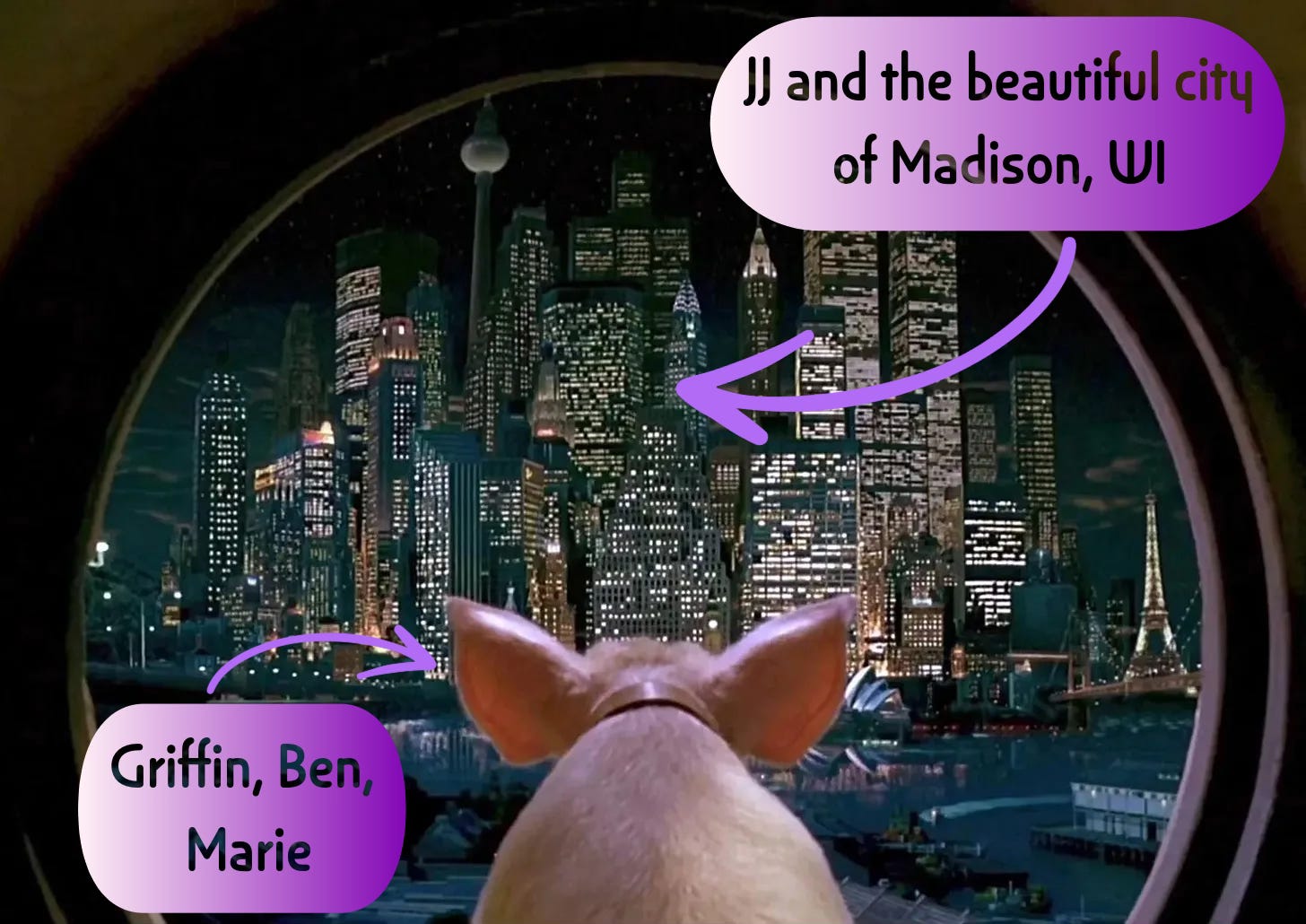
Tickets are now on sale for Blank Check’s show/screening of Babe: Pig in the City at the 2026 Wisconsin Film Festival in Madison on April 11th. Come and see Griffin, Ben, Marie, and JJ at the historic Barrymore Theatre, where a sharp-eared Burger Report caller once overheard JJ talking about Alex Ross Perry before a Jeff Tweedy solo gig. Tickets are just $12 and you can buy them HERE.

WHAT IS THE TEAM INTO THIS WEEK?
Griffin Newman, Host: “I went to see Past and Future Guest Jamie Lee (The Intern & Medicine Man eps) do her new show MY FRIEND KATY last night and I strongly recommend catching it for anyone who has the chance. It’s built around trying to solve the mysterious death of her best friend in the early 2000s but deftly uses that to examine our current cultural relationship to the true crime genre and motherhood at large, all while delivering an hour of consistent good-ass jokes. For any tri-state area Blankies she’ll be running it again at Union Hall in BK on 3/21! And for everyone else I recommend following @reallyjamielee on socials to see when and where she’ll be performing it next!
David Sims, Host: “I recommend finishing the Narnia books, which I just did (I interspersed with a GROWNUP BOOK between each edition). Here is my final ranking:
1 The Magician’s Nephew
2 The Silver Chair
3 The Voyage of the Dawn Treader
4 The Lion, the Witch, and the Wardrobe
5 Prince Caspian
6 The Horse and His Boy
7 The Last Battle more like the ASS battle”
AJ McKeon, Editor: “I’ll recommend Shadowbahn “a 2017 dystopian/road novel by Steve Erickson, known for its surreal, alternative history premise where the Twin Towers reappear in the South Dakota Badlands, prompting a strange road trip across a fractured America.” Past and future guest Chris Ryan mentioned it in passing on a recent episode of some Ringer show I was listening to and I grabbed it and it’s really interesting so far. ”
JJ Bersch, Researcher: “You seen these Bubly flavors they’re rolling out for the Super Mario Galaxy movie? Look, normally, I’m a Waterloo guy through and through, but you throw my lifelong friend on those boxes and I’m BUYING THEM ALL, YOU GOT ME, PEPSICO. I’ve yet to try Meteor Melon, not for lack of effort: our shipment got delayed. But both cosmic swirl (a vanilla berry kind of situation) and dragonfruit stardust (a dragonfruit stardust kind of situation) are hits. Long live the luma water.”
Marie Bardi, Social Media: “My friends Chadd Harbold (a producer and filmmaker) and Alan Palomo (a musician known as Neon Indian) started a new podcast called THIS PODCAST SHOULD BE PLAYED LOUD, about the film careers of different musicians. It’s a good time! I’m on a supersized two-part episode about Cher in the 1980s, the first episode of which is available now.
Alan Smithee, Pseudonymous Editor: “After having gotten stuck and putting it down a couple years ago, I picked Remedy’s game “Control” back up. Now that I’m further in than I was when I quit last time, I feel comfortable saying that it rules. It’s an action RPG set in an X-Files/Night Vale/SCP-inflected world (the whole thing takes place in an infinite office building full of monsters under New York City). I just got through a fight sequence scored to a Finnish heavy metal song that, frankly, owned bones.”

THIS WEEK ON THE PODCAST
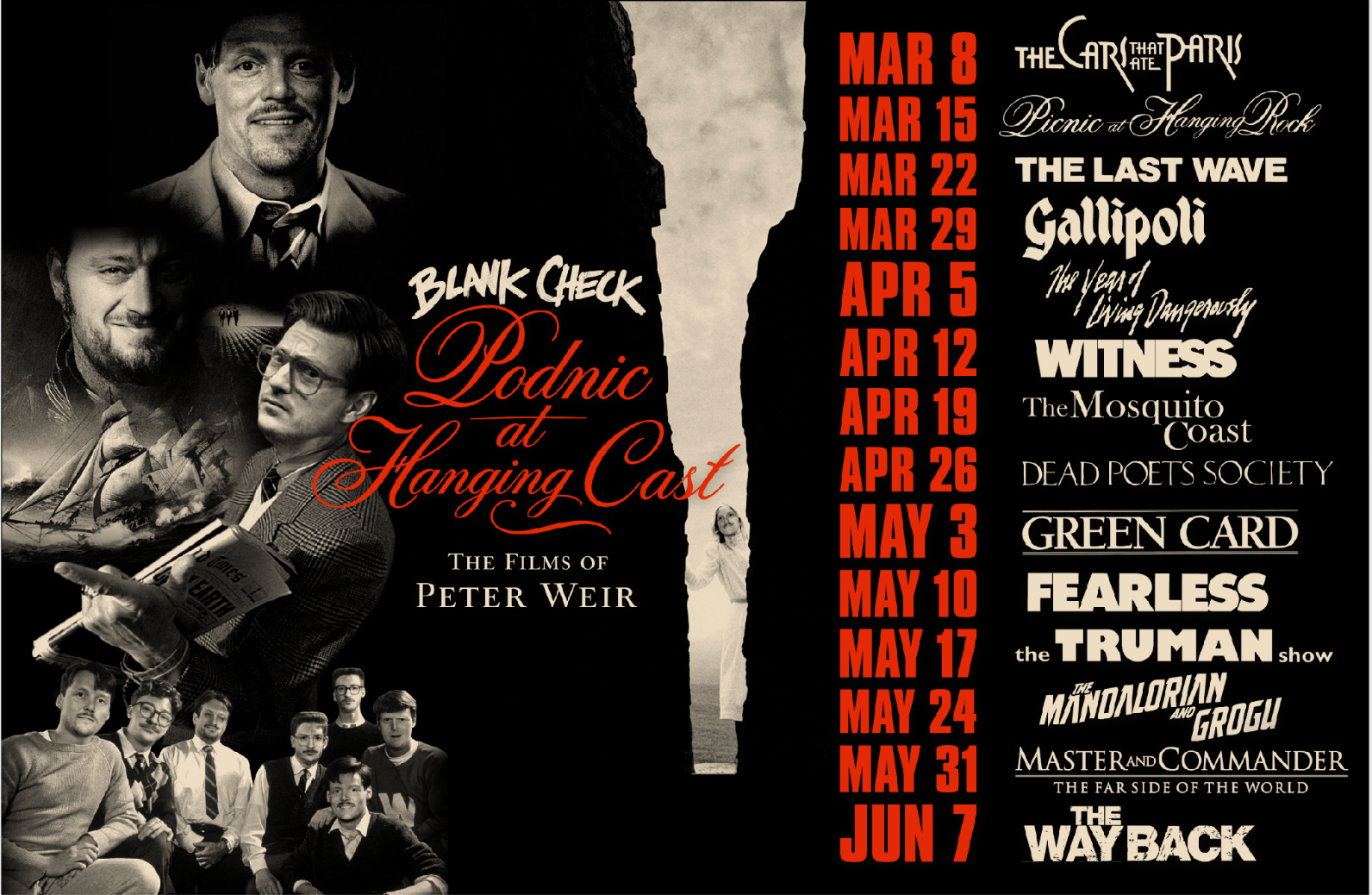
Our Peter Weir series PODNIC AT HANGING CAST kicks off with Weir’s 1974 feature debut The Cars That Ate Paris, a film about the guy who plays Napoleon in the Bill & Ted movies getting stranded in a quirky and murderous Australian town
CRITICAL DARLINGS
Sam Sanders of The Sam Sanders Show joins Richard and Alison to discuss Sinners, the most nominated film in Academy Awards history. Does this mean that the Academy is growing to be more accepting of Genre films?

MEANWHILE ON PATREON…..
And on Patreon, AAAAAAHHHAAAAAHAAAAAAAAAAAAAAA!! We’re defying gravity as we reach the epic (and unnecessarily) two-part conclusion to our Oz commentary series with 2024’s John M. Chu–directed Wicked (née Wicked: Part 1)


COMING SOON:

John C. Tibbetts interview, July 9-20, 2012, in Peter Weir: Interviews, ed. John C. Tibbetts.
Sue Mathews, 35mm Dreams, 1985, in Peter Weir: Interviews, ed. John C. Tibbetts.
Ibid.
Science Fiction: A Review of Speculative Literature, 1981, in Peter Weir: Interviews, ed. John C. Tibbetts.
Graham Shirley, 1991, in Peter Weir: Interviews, ed. John C. Tibbetts.
Ibid.
Tabula Rasa, 1994.
Tom Hogan, 1973, in Peter Weir: Interviews, ed. John C. Tibbetts.
Ibid.
Science Fiction: A Review of Speculative Literature, 1981, in Peter Weir: Interviews, ed. John C. Tibbetts.
Jonathan Rayner, The Films of Peter Weir, 41.
Film Quarterly, Summer 1980.
Not for the first time, I've found the story behind the inspiration of the film more interesting than the film.
The idea of a down and out former gold rush town now resorting to becoming Cornish Pirates and using the cover of high vis to lure unsuspecting tourists to their death is a great premise. And it's very true that a one off shotgun murder is going to grab 100x the attention that of over a dozen road fatalities.
I just wish all of that was more present in the film.
I'm with JJ on the Mario merch... I still don't love the movie design for Mario but they've nailed Yoshi and unfortunately for my wallet I'm finding myself buying A LOT of bullshit. I don't remember the last time we got this type of all-out movie merchandising (Star Wars?)