

Check Book: Oscars Post-Mortem
The end of a very long season


IN THIS WEEK’S EDITION:
THE BARDI PARTY REPORT
Bonjour mes amis. Greetings from Paris! I must level with you all - I’m exhausted. Staying up to watch the Oscars in Europe is no joke - the ceremony STARTED at midnight here in France, and I didn’t fall asleep until about 4:30 AM (the show ended at around 3:30 AM, but I was giddy and wanted to take a look at the Vanity Fair Oscar Party fashions!). When I complained about this to the Blank Check group, David Sims told me that growing up in England, he ALWAYS watched the Oscars at an ungodly hour…even as a kid. I guess I never realized the level of commitment that takes.
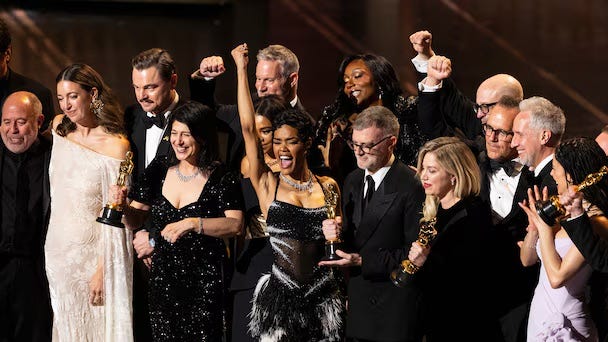
Some assorted thoughts on the telecast:
I thought Conan did a nice job again - the Weapons opening (which David predicted in yesterday’s episode!), the jabs at vertical video and unnecessary second-screen style exposition, and especially the beat-for-beat spoof of Lockjaw’s demise at the end of the show with Jim Downey reprising his role all killed for me. I also appreciated the REALLY stupid joke about the sequel to F1 being titled Caps Lock.
The In Memoriam segment was lovely. The array of actors who graced the stage in honor of Rob Reiner was overwhelming, Rachel McAdams felt like the perfect person to pay homage to both Catherine O’Hara and Diane Keaton, and of course local celebrity Barbra “Babs” Streisand brought the house down with her tribute to Robert Redford at the end. She had a podium mic for speaking and a handheld mic for singing. She is a pro. She is an icon. The Way We Were stills slaps.
Most of the presenter banter SUCKED. I don’t know if the jokes were badly written or the talent was under-rehearsed, or the energy in the room was off, but the bits were NOT hitting. Low points were Iron Man & Captain America talking about Channing Tatum’s thong (Doomsday is going to underperform, calling it now), and Bill and Lewis Pullman puttering and murmuring through a weird bit that compared editing to raising children? Everything felt awkward.
Speaking of awkward, the direction of the telecast felt messy. The sound mixing seemed off and there were multiple times the camera cut to Conan unexpectedly. I will say, though, that I really loved the stage design (okay Frank Lloyd Wright!) and the graphics package, which felt classic in all the right ways.
Javier Bardem continues to stand on business. An incredible turn of public opinion in the past two years to go from Jonathan Glazer getting booed to Bardem’s “Free Palestine” getting what seemed to be robust applause. I do wish people got more political last night in general. I think only one person directly alluded to the US media being controlled by oligarchs.
And now some thoughts on the winners:
I’m sure I’m not alone in being delighted to see Paul Thomas Anderson win not one, not two, but three Oscars last night, and for a film that feels so uncompromisingly HIM. They played an orchestral version of Dirty Work last night. Absolute perfection.
While I’m on the subject of OBAA, I’m so pleased it won Best Casting. A really great array of movie stars, older character actors, perfectly-cast non-actors, and a great discovery in Chase Infiniti.
I hope Sean Penn is having a great time in Ukraine.
Leo looked SO HOT and I think it’s because he has a sexy mustache like my husband does. Neil Bahadur on twitter said he looked like Jack Nicholson in Reds which is spot on. I love everything about this for him.
Congrats to past and future guest Zach Cregger, who directed Chicago legend Amy Madigan to victory. What a cool win! Hooray for horror!
Ryan Coogler just seems like the coolest guy. I love how he ran to carry Autumn Durald Arkapaw’s son down the aisle so he could be closer for her acceptance speech. What a moment! When she told all the women to stand up, Blank Check Woman stood up from her couch, too.
I’m not ready to unpack the Chalamet stuff yet. I need a few years of hindsight. I’m curious to see what he does post-Dune. What does a reset look like for him? I’m happy for Michael B. Jordan, who deserved to be nominated for both Creed and especially Black Panther.
Jessie Buckley gave a lovely speech. She seems quite nice. I did not like her movie, but I like her as a lady.
Honestly, it was a pretty solid group of awardees and I don’t really feel like complaining about any of them. Weird! I’m also just so tired so maybe I’ve run out of snark steam. Whatever. Movies are great, I’m glad we have them.

LET’S CRACK OPEN THE AUSSIER
Sowing Mysticism
In her biography of Picnic at Hanging Rock author Lady Joan Lindsay, Janelle McCullough writes, “According to those who were close to [Lindsay], she had certain abilities, sensitivities. She could ‘see’ things that others couldn’t, especially in the bush landscape. She knew things without being told. She could not only tell what had happened in the past, but also predict events in the future, without knowing why or how. And she could communicate with those who live in that grey space between life and the world beyond it.”1 Among those curious abilities, director Peter Weir revealed to his daughter Ingrid in an interview for Vogue Australia in 2015, was “a certain strange power to stop the clocks and watches in her presence,” which Lindsay—who never wore a watch for this reason—detailed in her autobiographical novel Time Without Clocks. One day, while walking with Lindsay in her immaculately kept garden in Mulberry Hill, Weir asked, “Tell me about this ability, or should I say misfortune, that makes clocks stop in your presence?” Lindsay’s response: “‘Well, I’m a gardener you know and we are rather strange people.’”2
Not Just Magic, Special Magic
One of the biggest influences on Weir’s film adaptation of Picnic at Hanging Rock was the multidisciplinary Australian artist Martin Sharp, who, Weir says, “was obsessed by the book and had a lot of interesting theories.”3 Though Weir could not think of an obvious title for the work Sharp wanted to do on Hanging Rock, Weir asked the artist to accompany him to set, where he served as a bouncing board for Weir’s ideas, as Weir told the National Film and Sound Archive Australia: “He forced me to dive deeper. We got on so well, I asked him to join us on the shoot. He had no specific role but ended up with the art department, collecting various props, like small personal items for the girls and the headmistress. These were more often than not specific to the individual, and they loved his choices. He brought a special magic to the shoot.”4 In an interview with The Guardian in 2005, Anne-Louise Lambert—who played Miranda—credited Sharp’s special magic with providing an entrypoint into her character: “Peter once said Miranda was more of a quality than a character. But … Martin Sharp, who knew Joan Lindsay and the book well, helped me find her. In my room, for example, if I opened a drawer, it was full of things he’d put there that were meaningful for Miranda: Valentine’s cards, handkerchiefs, pressed flowers, photographs in lockets.”5 Sharp would ultimately receive the credit of “artistic adviser to the director,” and I am disheartened that no one from Nintendo or Illumination ever reached out for me to serve a similar role on either of the Mario movies.
A Terrible Shock to the System
Originally cast as Mrs. Appleyard was British actress Vivien Merchant, who had been nominated for an Academy Award in 1967 for her supporting role in Alfie. Though, as producer Pat Lovell revealed to Cinema Papers, Merchant considered “herself a little bit young for the part … she was willing to go ahead anyway.” Sadly, Merchant soon “got ill and couldn’t come. It was really rather frightening.” A mad dash to find a replacement soon followed: “Rachel Roberts, who had been over-committed … was found to be available and in New York. So, there ensued an incredible —and it would have been very funny had it not been so deadly serious — business of trying to ring Rachel’s agency in New York from Mintaro, in South Australia, on a little wind-up phone with sheep walking past the window.” When Roberts arrived at Hanging Rock, she proved to be “a terrible shock to everybody, because I don’t quite know whether the McElroys or Peter realized how powerful an actress she was.”6 As detailed in a 2025 article in The Guardian, some of these shocks also came from actorly superstitions, as Roberts refused to wear the wig that had been designed for Merchant due to traditional behavior in the English theater community. But there were other shocks, too: “One night during the shoot, according to a 2004 documentary, she ran out of her motel room naked, hooting and yelling in the courtyard, as cast and crew watched on with bemusement. On other days, Guardian Australia was told, she could barely leave her motel room.” But at the end of the day, Weir said, Roberts unconventional process led to on-screen greatness: “Fame has to be left on the outskirts of the set. Once an actor crosses into that magic circle they have a job to do. The best, like Rachel, understand this.”7
Subliminal Sounds
Much of the praise for Picnic at Hanging Rock’s unmatched atmosphere has been justifiably directed towards cinematographer Russell Boyd, whose bag of low-budget tricks invented both Sofia Coppola and Instagram in one fell swoop. But one of the more peculiar aesthetic tricks pulled in the film is its soundtrack—and I don’t mean the pan flutes. As Weir told DGA Quarterly in 2010, before shooting Hanging Rock, “I’d read somewhere that there are certain primal sounds that are in a way in our DNA, because they’d been experienced before by humankind, and one of those sounds is an earthquake.” And so, Weir continued, “I got hold of a recording of an earthquake, and we experimented with the optical soundtrack so that it would register but you wouldn’t be able to identify it as the sound of an earthquake. We slowed it down a little, and I’d use that sound sometimes in sequences where there was no reason to expect anything like that—in a landscape or even in an interior shot, where I’d add it to the natural sounds outside the window. It would just register as a low rumble, indistinct. It really only worked in optimum sound systems, but I do think it contributed something.”8 It was a stylistic choice Weir would repeat on his next film, too: “With the soundtrack I used white noise, or sounds that were inaudible to the human ear, but were constantly there on the track. I’ve used earthquakes quite a lot, for example, slowed down or sometimes mixed with something else. I’ve had comments from people on both Picnic and Last Wave saying that there were odd moments during the film when they felt a strange disassociation from time and place. Those technical tricks contributed to that.”9 So listen up—on an optimum system—as you watch ahead of next week’s episode.
Appleyard’s Offscreen Fate
Did you know that they shot an alternate ending for Picnic at Hanging Rock? If not, you do now! Here’s Boyd, with the details: “We shot an alternative ending where Mrs. Appleyard decides to go up to the Rock to find out exactly where the girls disappeared. … And one of the scenes we shot was her body being carried back down on a stretcher. Peter just decided not to use it.”10 And here’s Weir, on why he never even entertained using it in the edit: “[T]he last closeup of Rachel, a world of pain on her face, was so powerful I knew it had to be the closing shot – we didn’t even bother to cut together the other ending.”11 And with that we have arrived at the true ending of this week’s newsletter: it is time for me to go shovel the foot-plus of snow that has accumulated outside of my house.

BLANK CHECK PRESENTS BABE: PIG IN THE CITY LIVE
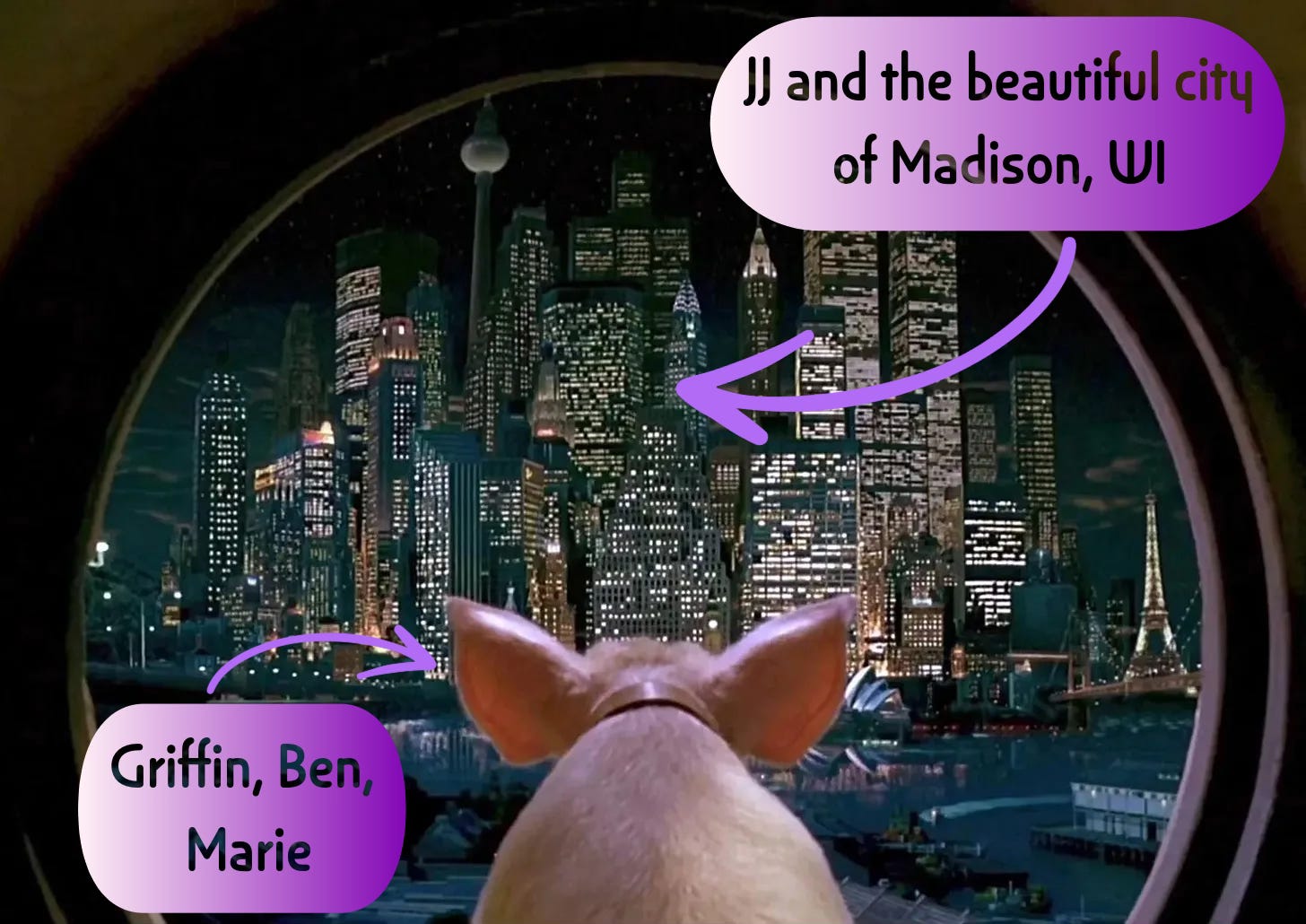
Tickets are now on sale for Blank Check’s show/screening of Babe: Pig in the City at the 2026 Wisconsin Film Festival at the Barrymore Theatre in Madison on April 11th. They are just $12 and you can buy them HERE. The foot of snow outside of JJ’s house will be MELTED by that point.

WHAT IS THE TEAM INTO THIS WEEK?
David Sims, Host: “I’m in a French mood actually as I move through all my discs!! I watched the Rohmer Seasons and the Antoine Doinel movies to feel closer to Marie, I miss France. My fave is A Tale of Winter but my biggest crush is Margot from Tale of Summer”
AJ McKeon, Editor: “I’ll recommend Flatstock. It’s part of South by Southwest every year, but it also appears at other festivals. It’s totally free and features some of the best poster artists showcasing their work. It’s free to the public.
By the time you’re reading this it will be over, but check out https://posterinstitute.org/events/ for other events coming up. Support actual artists and the art of screen-printing. It’s cool as hell.”
JJ Bersch, Researcher: “I am playing lots of video games right now but the one I can’t stop thinking about is Marathon, which I think is brilliant in so many ways that people will be talking about for a long time!!! (And also so fun.)”
Marie Bardi, Social Media: “I can’t stop playing Pokopia. Does Peakychu ever turn into normal Pikachu? Inquiring minds would like to know.”
Alan Smithee, Pseudonymous Editor: “For the Picnic at Hanging Rock heads out there, I recommend the novel “Sacred and Terrible Air” by Robert Kurvitz (creator of Disco Elysium). It is something like PAHR, but set in the DE universe (those who haven’t played that game should save reading this until they have, and everyone should). It goes pretty cuckoo crazy bonkers as it goes along, but toward the beginning, it captures something of the haunted feeling of Hanging Rock. There isn’t an official English translation of the book (Kurvitz writes in Estonian…), but a bunch of Disco Elysium fans coordinated a translation project, and you can find their English version for free on Reddit.”

THIS WEEK ON THE PODCAST
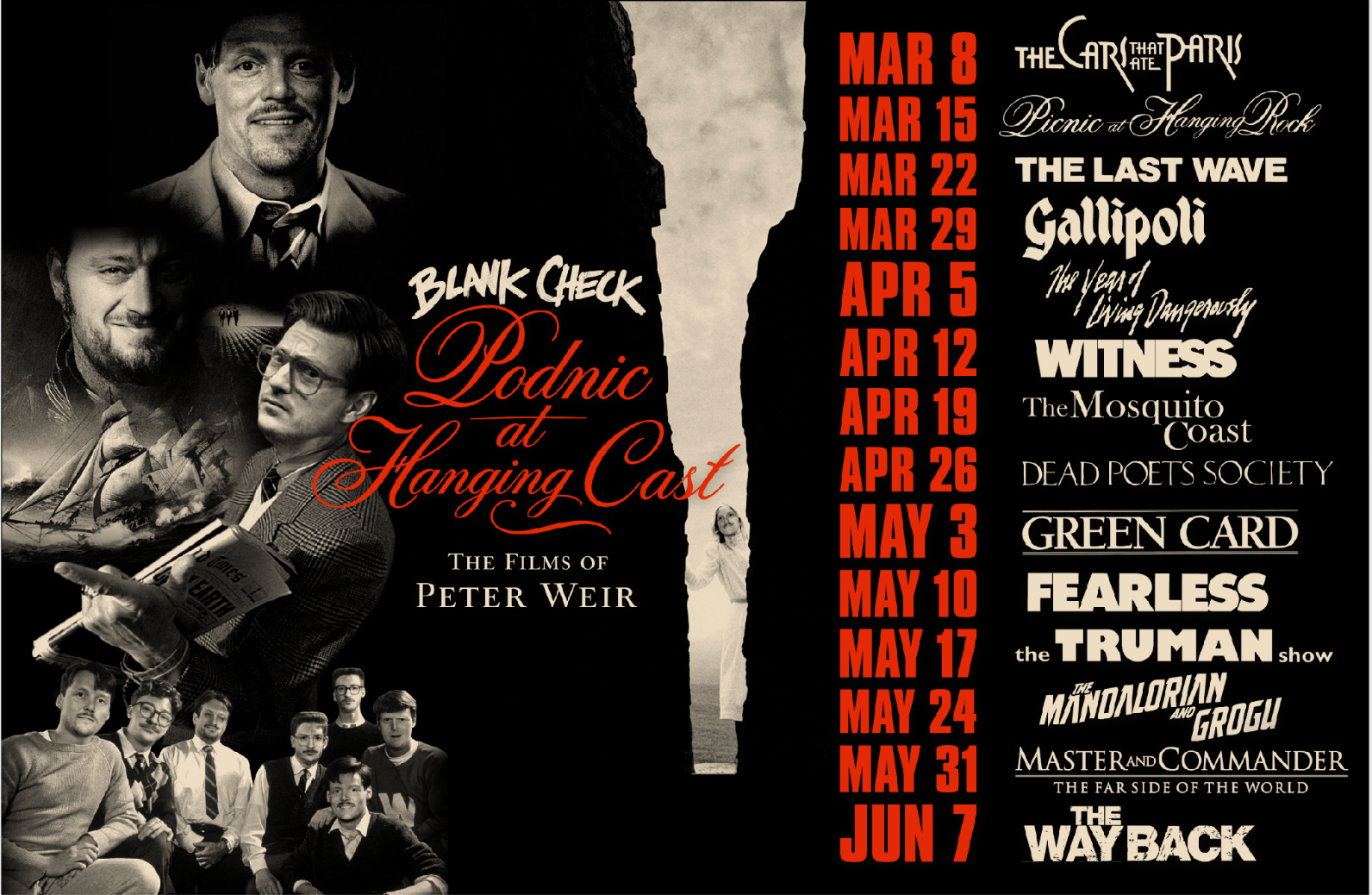
Get your pan flutes out. Jane Schoenbrun joins us to chat about the 1975 classic of Australian cinema, Picnic at Hanging Rock.
CRITICAL DARLINGS
Get a refresh on what Alison and Richard thought would happen last night at the 98th Academy Awards as they discuss One Battle After Another and Oscar predictions with David Sims.”
MEANWHILE ON PATREON…..
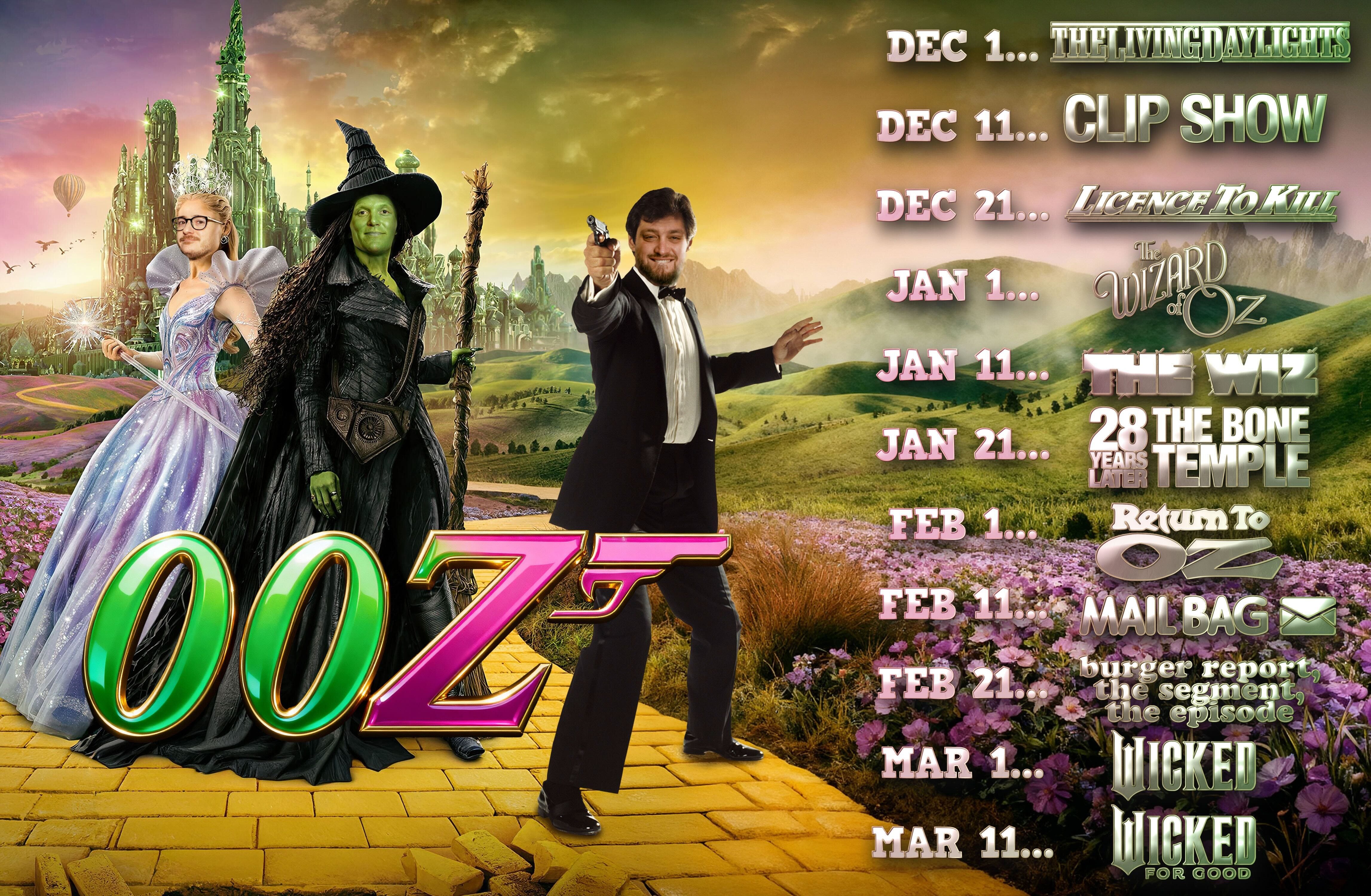
And on Patreon, it’s the EPIC conclusion that nobody asked for, as we epically conclude our Oz commentary series that everyone asked for with Wicked: For Good.


COMING SOON:
The Sydney Morning Herald, March 30, 2017.
Vogue Australia, 2015.
Sue Mathews, 35mm Dreams: Conversations with Five Directors about the Australian film revival, 93.
National Film and Sound Archive Australia.
The Guardian, February 17, 2005.
Cinema Papers, March-April 1976.
The Guardian, April 10, 2025.
DGA Quarterly, Summer 2010.
Matthews, 35mm Dreams, 95.
John C. Tibbetts interview, July 9-21, 2012, in Peter Weir: Interviews, ed. John C. Tibbetts.
The Guardian, February 17, 2005.
For anybody looking for more Picnic at Hanging Rock Fun Facts, check out the “Excised final chapter” portion of the novel’s Wikipedia page!
"Movies are great, I'm glad we have them" sums it up indeed!